Development, Needs, and Privacy: What Telegram Group Defense Reveals About a Technologist’s Fixations—and the Way Out
如果非要给自己下一个定义,我可能并非一个纯粹的程序员。
更准确地说,我是半个程序员、半个美工,再加半个产品经理。
从本科被微机原理折磨,到2012年开始折腾博客(从WordPress到Hexo,再到如今的Halo),这些年在代码和系统里学习进步,让我积累了不少经验教训,也让我渐渐看清了一些技术之外的东西。有些话卡在喉咙里憋了很久,今天索性借着这篇文章,把自己的理解做个梳理。
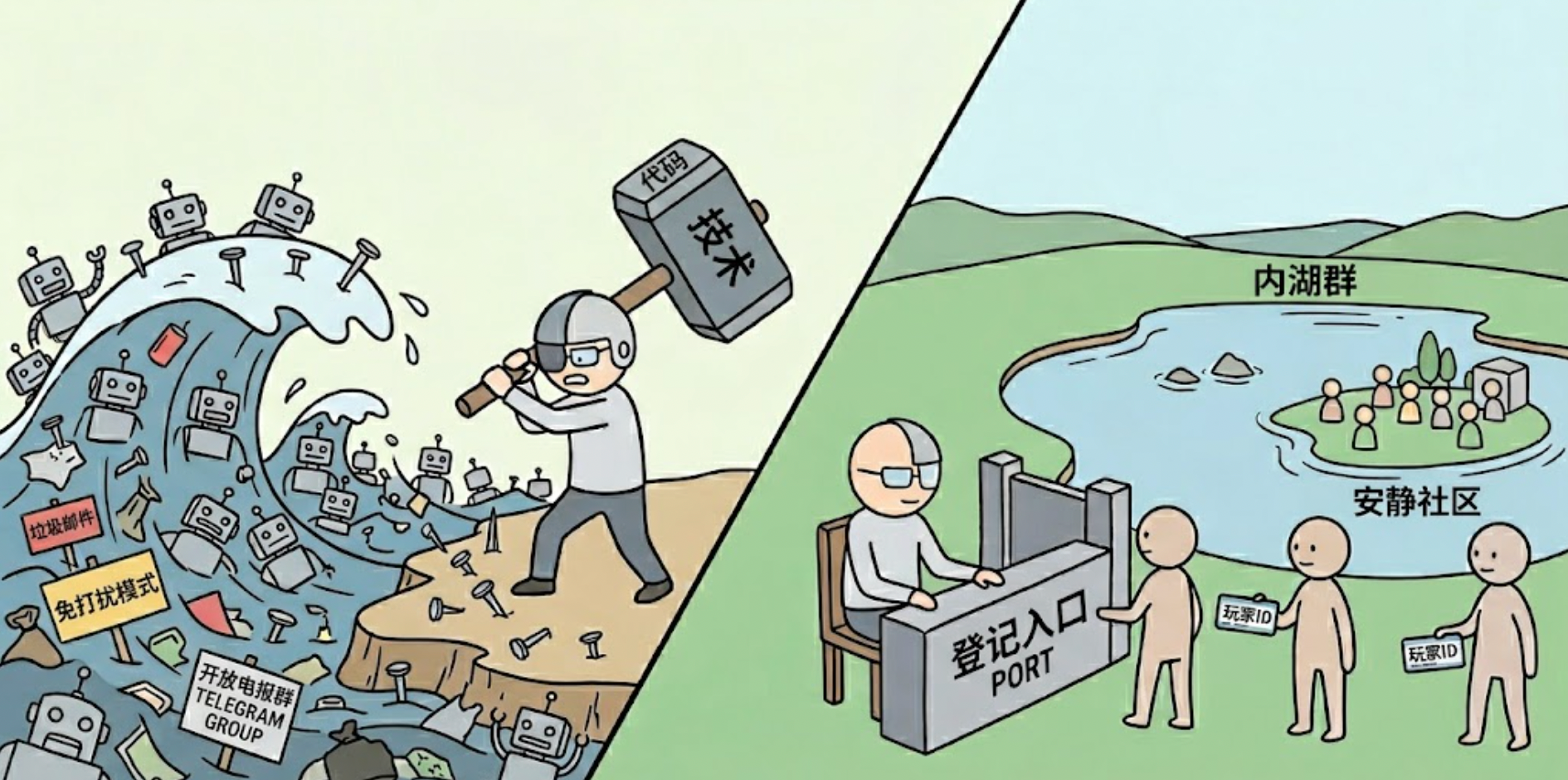
一、 程序员的诅咒:手里有锤子,看什么都像钉子
技术圈里有句老话:“当你有一把锤子,那你看什么都像钉子。”
这几乎是每一个具备开发能力的程序员难以逃脱的诅咒。面对问题,我们的第一反应往往是:既然我有这个能力,那我写段代码把它搞定。
动手写代码本身没有任何毛病,这是我们改变世界的武器。但问题恰恰出在“需求定义”这一步。如果在一开始就没有想清楚自己真正要的是什么,只是在错误的方向上勤勤恳恳地修修补补,那么投入再多的精力也只会如泥牛入海。
在最适合的场景下,做最恰如其分的开发,才是技术的正道。
二、 海湾上的防洪堤:Telegram的灰产与防线
众所周知,Telegram某种程度上就像是一个赛博版的“九龙城寨”,不像是微信、Whatsapp等相对强监管的IM软件,各种灰色、黑色的自动化产业都在这里野蛮生长。相比之下,像 Ingress 这样的游戏社群,已经算是这片混沌中颇为干净的一隅。
但Tg开放且好用的Bot API机制,是一把极致的双刃剑:
- 对于灰黑产程序员: 他们手里握着海量的虚拟身份、手机号和邮箱。利用代码在Tg上实现自动化的加群、信息爬取、监控和广告投放,简直是手到擒来。
- 对于懂技术的普通玩家: 我们也可以利用官方的正规接口,开发群管Bot,实现验证、踢人、防广告等自动化管理。
这就引出了一个极其典型的攻防案例:近期各大 Ingress 游戏群被 Tg 黑产 Bot 狂轰滥炸的困局。
目前,解决“清理广告Bot”这个刚需,社群里主要有三种路径:
- 彻底封闭(人工邀请): 群转为私密,完全靠熟人拉拽。最安全,但也最封闭,容易形成孤岛。
- 设立缓冲区(预备群验证): 主群私密,设立公开的预备群,玩家在预备群验证身份后,获取主群进入权限。
- 大门敞开(Bot进群验证): 群保持公开,任何人/Bot都能进。新账号进群后,由管理Bot下发验证题,限时未通过则踢出。
目前,绝大多数的群组选择了方案3。
三、 虚假的繁荣与被消耗的日活
明明关上门就可以做到小而美,却非要大敞四开等人冲。选择方案3的初衷听起来很美好:“为了对新人友好。”
于是,这就造就了一个极其荒诞的现状:在一个名义500人,实际真人日均消息量可能不足50条的群里,每天会有形形色色的Bot反复进出,数量可以达到二三十次。伴随而来的是满屏的“请回答验证问题”、“超时已被移出群组”的系统提示。偶尔遇到技术升级的漏网之鱼,还能成功进群发一坨垃圾广告。
从结果上看,群管Bot确实拦住了大部分黑产bot。但隐患却在暗中滋生:
- 劣币驱逐良币: 没有人喜欢被毫无营养的Bot进出提示刷屏。
- 社区活力的丧失: 新人没见增加几个,老玩家却因为不堪其扰,纷纷将群组设为“静音(Mute)”。
群组没了通知,就没了触达;没了触达,参与和日活便会断崖式下跌。
我们不妨回归常识,重新审视所谓“对新人友好”的命题。
对于一个想加入组织的新人来说:
- 路径A: 直接点进主群,面对一堆连老玩家都要辨认半天的验证图片(比如识别什么是 XMP,什么是 Cube)。
- 路径B: 点击进入预备群,报上自己的游戏ID和活动区域,传一张Profile截图,等待管理员审核后发放专属链接。
这二者对新人的体验,真的有天壤之别吗?为了一个不知道哪里来的“新人”的“来去自由”,任由无数黑产Bot在主群肆虐,导致正常群友被迫开启勿扰模式。为爱发电的管理员和群友在“四个图是不是不够难”、“要不要缩短验证时间”的军备竞赛中无限内耗。
如果问题一开始就问错了,那怎么答都是错的。
四、 降维打击:不要用业余爱好挑战别人的KPI
Tg的单个群组上限是20万人。对于那些需要极致开放性、需要引流的黑色产业来说,敞开大门是他们的刚需。毕竟只有广撒网,才能上鱼。
但对于一个国内顶天几百人、国外最多不过两三千人的游戏群组来说,真的需要这种毫无边界的开放吗?
更残酷的现实是双方的战力并不对等。
- 防守方: 是一群“为爱发电、看心情上岗”的破游玩家。
- 进攻方: 是“坑到一个就赚一笔”、最新漏洞秒利用,甚至身在缅北、完不成数据就要挨电棍的硬核灰产程序员。
你试图用业余时间搓出来的防线,去对抗别人赖以生存的spam大军,这种努力不仅性价比极低,而且注定会被降维打击。退一万步讲,就算你的Bot完美无瑕,能够精准识别游戏道具,把垃圾账号一个不漏地踢出去,它也无法消除SPAM提示扰民的问题。
更何况,这个“先进来再筛选”的逻辑根本无法泛化推广。在小众领域你还能让Bot识别游戏道具,如果推广到普通群,难道要让Bot去识别小泽老师还是苍井老师?识别比特币还是以太币?在视觉大模型(VLM)普及的今天,这种基于规则的图片验证Bot被攻破,只是时间问题。不被针对,仅仅是因为池子太小,还没有被盯上的价值。
五、 隐私与规则:在内陆湖里建起防洪堤
试图用代码在开放的港湾里建防洪堤,从治标的角度看,最多只能打70分。那么,什么是治本?这就需要回到我们最初的问题:什么是真正的需求?
玩家的核心需求是:需要一个可以公开吹水闲聊的大群,且不应该随时被进群验证的系统消息骚扰。
解决思路其实非常清晰:填海造陆,把海湾改成内陆湖,只留一个通航窗口。
答案就是预备群+登记制。
进主群前,先在预备群填一下游戏ID,发个Profile截图,验证通过后发放一次性链接。这样一来,主群自然清净。
如果这时候有人跳出来拿“隐私”说事,认为登记ID侵犯了个人边界,那这就涉及到身份隔离的本质了。
游戏群成员的本质是“游戏玩家”,而游戏玩家必然拥有一个游戏ID。用ID作为进群的通行证,这本身就是一种合理的身份隔离(ID并非强实名,只是一个虚拟标志)。这就好比开车上路需要车牌号: 你知道有人能通过车牌号查到你的行踪,你甚至可以搞套牌。但是,如果你理直气壮地说:“我就是要开着一辆无牌车在马路上横冲直撞。” 那这就多多少少有点不讲理了。凭什么你要搞特殊?凭什么大家要由着你这么做?你撞车逃逸怎么办?
结语:跳出代码视角的执拗
程序员有着自己固执的视角(比如数数一定要从0开始)。但如果沉溺于代码本身,认为自己的技术视角就是绝对正确,把别人提出的产品意见都视为对自身付出的否定,那就落入了偏执的陷阱。
当别人抱怨“群里广告Bot不断,你能不能写点代码踢一下”时,不要急着去翻 API 文档死磕黑产。多往深处看两层,你会发现:既然大海波涛汹涌,本质我们又是个内陆湖的规模和需求,为什么不把航道收拢,实行进港登记?
简单、管用、不留后患。 这不是“术”的修补,而是“道”的升维;
不是在代码里找Bug,而是在逻辑中抓住了最根本的矛盾。
在这场技术与需求的博弈中,想清楚边界在哪,往往比写出多优雅的代码,重要得多。
If I had to define myself, I probably would not call myself purely a programmer.
More precisely, I am half programmer, half graphic designer, plus half a product manager.
From being tormented by microcomputer principles as an undergraduate to tinkering with blogs from 2012 onward—from WordPress to Hexo to today’s Halo—years of learning through code and systems have taught me plenty of lessons and gradually brought things beyond technology into focus. Some thoughts have been stuck in my throat for a long time; today I will use this article to put them in order.
1. The Programmer’s Curse: When You Have a Hammer, Everything Looks Like a Nail
There is an old saying in tech: “When you have a hammer, everything looks like a nail.”
It is a curse that almost every programmer capable of building things struggles to escape. When faced with a problem, our first reaction is often: I have the ability, so I will write some code and fix it.
There is nothing wrong with writing code; it is our tool for changing the world. The problem lies precisely in defining the need. If we have not first understood what we actually want, and merely keep diligently patching things in the wrong direction, no amount of effort will produce a return.
The right use of technology is to build exactly what the situation calls for, where it fits best.
2. A Flood Barrier Across a Bay: Telegram’s Shady Industries and Defenses
As everyone knows, Telegram is in some respects a cyber Kowloon Walled City; unlike relatively tightly regulated messengers such as WeChat or WhatsApp, it has become fertile ground for all kinds of gray- and black-market automation. By comparison, gaming communities such as Ingress are among the cleaner corners of this chaos.
But Telegram’s open, convenient Bot API is the ultimate double-edged sword:
- For programmers in shady or illegal businesses: they hold vast numbers of virtual identities, phone numbers, and email addresses. Using code to automate joining groups, scraping information, monitoring, and advertising on Telegram is child’s play.
- For ordinary technically minded players: we too can use the official, legitimate interfaces to build moderation bots that automate verification, removals, and spam prevention.
That brings us to a textbook attack-and-defense case: the recent bombardment of major Ingress groups by Telegram spam bots.
The community currently has three main approaches to the pressing need to clear out advertising bots:
- Close completely—manual invitations: make the group private and rely entirely on existing acquaintances to invite people. Safest, but also most closed, and liable to become an island.
- Create a buffer—verification in a waiting group: keep the main group private, with a public preliminary group where players verify their identity before receiving access.
- Leave the door open—bot verification after joining: keep the group public so anyone, including bots, can enter. A moderation bot gives newcomers a challenge and removes them if they fail to pass within the time limit.
Most groups have chosen option 3.
3. False Activity and Daily Engagement Worn Away
We could close the door and keep things small and pleasant, yet insist on leaving it wide open for intruders. The intention behind option 3 sounds lovely: “Make it welcoming to newcomers.”
The result is absurd: a nominally 500-person group, where real humans may send fewer than 50 messages a day, sees all manner of bots coming and going twenty or thirty times daily. The screen fills with “Please answer the verification question” and “Removed for exceeding the time limit.” Occasionally, an upgraded bot slips through and successfully dumps a pile of junk ads.
Judged by the immediate result, the moderation bot does stop most malicious bots. But hidden problems are taking root:
- Bad drives out good: nobody likes their screen flooded with pointless bot arrival and departure notices.
- Community vitality drains away: few newcomers materialize, while established players, tired of the disruption, increasingly mute the group.
Without notifications, the group no longer reaches people; Without that reach, participation and daily activity fall off a cliff.
Let us return to common sense and reconsider what “welcoming to newcomers” means.
For a new player looking to join a community:
- Route A: click directly into the main group and confront verification images that even experienced players need time to identify—say, which is an XMP and which is a Cube.
- Route B: enter the preliminary group, give your game ID and playing area, upload a Profile screenshot, and wait for an administrator to approve you and issue a personal link.
Are those experiences really worlds apart for a newcomer? For the sake of the “freedom to come and go” of some unknown “newcomer,” we let countless malicious bots run wild in the main group and force genuine members into Do Not Disturb. Volunteer admins and members exhaust themselves in an endless arms race: “Are four images too easy?” “Should we shorten the time limit?”
If the question was wrong to begin with, every answer will be wrong.
4. Outmatched: Do Not Pit Your Hobby Against Someone Else’s Performance Targets
A Telegram group can hold 200,000 people. For illicit businesses that need maximum openness and traffic, an open door is essential. Only a wide net catches fish.
But does a gaming group with at most a few hundred people in China, or two or three thousand overseas, really need that kind of boundless openness?
The harsher reality is that the two sides are not evenly matched.
- Defenders: a bunch of players of this damn game, “volunteering for love and showing up when they feel like it.”
- Attackers: hardened gray-market programmers who “earn for every victim,” exploit new vulnerabilities immediately, and may even be in northern Myanmar, facing electric batons if they miss their quotas.
Trying to defend with something built in your spare time against a spam army someone depends on for survival is not just poor value for effort; you are destined to be outclassed. Even granting a flawless bot that identifies game items perfectly and removes every junk account, it still cannot eliminate the nuisance of spam-related system messages.
Worse, “let them in, then filter” is not a generalizable approach. A niche group can use game items, but in ordinary groups, should the bot distinguish Ozawa-sensei from Aoi-sensei? Bitcoin from Ether? With vision-language models now widespread, rule-based image-verification bots will be defeated sooner or later. If you are not being targeted, it is only because your pool is too small to be worth their attention yet.
5. Privacy and Rules: Build Your Barrier Around an Inland Lake
Trying to use code to build a flood barrier across an open harbor earns, at best, 70 out of 100 for treating symptoms. What would address the cause? For that, we must return to our original question: what do we actually need?
Players’ core need is a large group where they can chat together openly, without constant disruption from join-verification system messages.
The solution is clear: reclaim the sea, turn the bay into an inland lake, and leave just one navigable entrance.
The answer is a preliminary group plus registration.
Before entering the main group, provide a game ID and Profile screenshot in the preliminary group, then receive a single-use link after verification. The main group becomes quiet naturally.
If someone then invokes “privacy,” arguing that registering an ID crosses personal boundaries, we must consider what separating identities actually means.
A gaming group consists, fundamentally, of game players, and a game player necessarily has a game ID. Using that ID as an entry pass is itself a reasonable separation of identity: it is not mandatory real-name identification, merely a virtual identifier. It is like needing a license plate to drive on a road: you know someone may trace your movements through it, and you could even use a cloned plate. But if you insist, “I demand the right to drive a plateless car wherever I please.” That is rather unreasonable. Why should you be special? Why should everyone indulge you? What if you hit someone and run?
Conclusion: Step Outside the Code-Centered Mindset
Programmers have their own stubborn perspectives—for example, counting simply must start at zero. But if we become absorbed in the code, regard our technical perspective as unquestionably correct, and treat all product feedback as a rejection of our effort, we have fallen into the trap of obsession.
When someone complains, “The group is full of advertising bots; could you write some code to kick them out?” do not rush to the API documentation for a fight with the spammers. Look a couple of layers deeper: if the sea is rough, but our size and needs are really those of an inland lake, why not narrow the channel and register arrivals?
Simple, effective, and without lingering trouble. This is not patching the technique, but raising the level of the underlying approach;
Not looking for a bug in the code, but finding the fundamental contradiction in the reasoning.
In this interplay between technology and needs, understanding where the boundaries lie often matters far more than writing elegant code.
自分を定義するとしたら、純粋なプログラマーではないのかもしれない。
もっと正確に言えば、半分プログラマー、半分デザイナー、それに半分プロダクトマネージャーだ。
学部時代にマイコンの原理で苦しめられ、2012年からはWordPress、Hexo、そして現在のHaloへとブログをいじってきた。コードやシステムを通じて学んだ年月は、多くの教訓をもたらすとともに、技術以外のことも少しずつ見えるようにしてくれた。長く喉に引っかかっていた言葉がある。今日はこの記事で、自分の考えを整理してみたい。
一、プログラマーの呪い――ハンマーを持つと、何でも釘に見える
技術の世界には昔から、「ハンマーを持っていると、何でも釘に見える」という言葉がある。
開発能力のあるプログラマーなら、ほとんど誰もが逃れがたい呪いだ。問題を見ると、まず「できるのだから、コードを書いて解決しよう」と考えがちになる。
コードを書くこと自体に問題はない。それは世界を変えるための道具だ。問題は、まさに「何が必要かを定める」段階にある。最初に本当に欲しいものを考えず、間違った方向でまじめに修正を重ねているだけなら、いくら力を注いでも海に消える泥牛のように戻ってこない。
最もふさわしい場面で、必要にぴったり合う開発をすることこそ、技術の正しい使い方だ。
二、湾に築く防潮堤――Telegramのグレーな産業と防衛線
周知のとおり、Telegramはある意味、サイバー版の九龍城砦だ。WeChatやWhatsAppのような比較的管理の厳しいメッセンジャーとは異なり、グレーや違法な自動化ビジネスが野放図に育っている。その中では、Ingressのようなゲームコミュニティは、比較的きれいな片隅と言っていい。
ただし、Telegramの開放的で便利なBot APIは、究極の両刃の剣だ。
- グレー・違法ビジネスのプログラマーにとっては:大量の仮想ID、電話番号、メールアドレスが手元にある。コードを使ってTelegramでの参加、情報収集、監視、広告配信を自動化するのは、たやすいことだ。
- 技術の分かる一般プレイヤーにとっては:こちらも正式な公式インターフェースで管理Botを作り、認証、退出処理、広告防止などを自動化できる。
ここに典型的な攻防の事例がある。最近、Ingressの各グループがTelegramの悪質Botによる集中攻撃にさらされている問題だ。
「広告Botを排除する」という切実な課題に対し、コミュニティでは主に3つの方法が取られている。
- 完全に閉じる(手動招待):非公開グループにして、知り合いの紹介だけで参加してもらう。最も安全だが、最も閉鎖的でもあり、孤島になりやすい。
- 緩衝地帯を設ける(予備グループで認証):本体は非公開にし、公開の予備グループで身元を確認した後、本体への参加権を渡す。
- 門戸を開く(参加後にBot認証):グループを公開し、人でもBotでも入れるようにする。新規アカウントが入ると管理Botが認証問題を出し、時間内に通過できなければ退出させる。
現在、圧倒的多数のグループが方法3を選んでいる。
三、見せかけのにぎわいと、削られる日々の参加
扉を閉じれば小さく快適にできるのに、わざわざ開け放して突入を待つ。方法3を選ぶ当初の意図は、聞こえがいい。「新規参加者に優しくするため」だ。
その結果は実に不条理だ。名目500人、人間の投稿は1日50件にも満たないかもしれないグループで、さまざまなBotが毎日20~30回も出入りする。画面には「認証問題に答えてください」「時間切れのため退出させました」という通知が並ぶ。時には技術を更新したBotがすり抜け、ゴミ広告をひとかたまり投下する。
目先の結果だけ見れば、管理Botは悪質Botの大半を防いでいる。しかし、その陰で別の問題が育っている。
- 悪貨が良貨を駆逐する:中身のないBotの入退室通知で埋め尽くされるのを、喜ぶ人はいない。
- コミュニティが活気を失う:新規参加者はさほど増えず、古参はうんざりして次々にグループをミュートする。
通知がなくなれば情報は届かない。届かなくなれば参加も日々の活動も急落する。
常識に立ち返り、「新規参加者に優しい」とは何かを考え直そう。
コミュニティに入りたい新人にとって、
- 経路A:直接メイングループへ入り、XMPとCubeの見分けなど、古参でも少し考える認証画像に向き合う。
- 経路B:予備グループに入り、ゲームIDと活動地域を伝え、Profile画像を送り、管理者の確認後に専用リンクを受け取る。
新人にとって、この二つは本当に天と地ほど違う体験だろうか?どこから来たか分からない「新人」の「出入りの自由」のために、無数の悪質Botを本体で暴れさせ、普通のメンバーに通知オフを強いている。善意で支える管理者やメンバーは、「画像4枚では簡単すぎるか」「認証時間を短くするか」という軍拡競争で、際限なく疲弊する。
最初の問いを間違えていたら、どう答えても間違いだ。
四、勝負の土俵が違う――趣味で他人のノルマに挑むな
Telegramの1グループの上限は20万人だ。極限までの開放性と集客を求める違法ビジネスには、門戸を開くことが不可欠になる。広く網を張らなければ、魚はかからないからだ。
しかし、国内なら多くても数百人、海外でも2000~3000人程度のゲームグループに、本当にそんな無制限の開放性が必要なのか?
さらに厳しい現実は、両者の戦力が釣り合っていないことだ。
- 守る側:「好きだから無償で動き、気分で出勤する」ポンコツゲームのプレイヤーたち。
- 攻める側:「一人だませば一件分の稼ぎ」、最新の脆弱性は即利用、場合によってはミャンマー北部にいて、ノルマ未達なら電気棒で罰されるような、筋金入りのグレー産業プログラマーだ。
余暇に作った防衛線で、相手が生計を懸けるspam軍団に対抗しようとしても、労力に見合わないだけでなく、勝負の次元からして圧倒される。百歩譲ってBotが完璧で、ゲームアイテムを正確に認識し、迷惑アカウントを一つ残らず追い出せても、spam関連の通知が人を煩わせる問題は消せない。
そもそも「先に入れてから選別する」という方式は、一般化できない。ニッチな分野ならゲームアイテムを見分けさせられても、普通のグループでは、小澤先生と蒼井先生を見分けさせるのか?ビットコインとイーサを見分けるのか?視覚言語モデル(VLM)が普及した今、こうした規則ベースの画像認証Botが突破されるのは時間の問題だ。狙われていないのは、池が小さすぎて、まだ目を付ける価値がないだけだ。
五、プライバシーとルール――内陸の湖に防護堤を築く
開いた湾にコードで防潮堤を築こうとしても、対症療法としてせいぜい70点だ。では、根本の解決とは何か?最初の問いに戻る必要がある。本当のニーズは何なのか?
プレイヤーの本質的なニーズは、皆で気軽に雑談できる大きなグループであり、参加認証のシステム通知にいつも邪魔されないことだ。
解決の方向は明快だ。海を埋め立てて湾を内陸の湖に変え、船の出入口を一つだけ残す。
答えは、予備グループ+登録制だ。
本体へ入る前に、予備グループでゲームIDとProfile画像を送り、確認後に一度だけ使えるリンクを受け取る。そうすれば、本体は自然に静かになる。
ここで「プライバシー」を持ち出し、ID登録は個人の境界を侵すと言う人がいるなら、身元を切り分けることの本質を考える必要がある。
ゲームグループのメンバーは、本質的に「ゲームのプレイヤー」であり、プレイヤーなら必ずゲームIDを持っている。IDを入場券とすること自体が、合理的な身元の切り分けだ。IDは厳格な実名確認ではなく、仮想的な識別子にすぎない。道路を走る車にナンバープレートが必要なのと同じだ。そこから行動を調べられる可能性は分かっているし、偽装ナンバーを使うことだってできる。だが、当然の権利のように「ナンバーのない車で好き勝手に走り回りたい」と言い張るなら、それは少々筋が通らない。なぜ自分だけ特別扱いなのか?なぜ皆が付き合わなければならないのか?事故を起こして逃げたらどうするのか?
結び――コードの視点への固執から抜け出す
プログラマーには独特のこだわりがある。たとえば、数は必ず0から数える、といったものだ。だがコードそのものに没頭し、自分の技術的視点が絶対に正しいと考え、他人のプロダクト上の意見を努力の否定と受け取るなら、偏執の罠に陥っている。
「広告Botが絶えないから、追い出すコードを書いてくれない?」と頼まれても、すぐAPI資料を開いて悪質業者と戦おうとしなくていい。もう二段階ほど深く考えれば分かる。海が荒れていても、こちらの規模もニーズも内陸の湖なのなら、航路を絞って入港登録制にすればいいのではないか?
単純で、役に立ち、後腐れがない。これは「術」の修繕ではなく、「道」の見方を一段上げることだ。
コードのBugを探すのではなく、論理の中にある根本的な矛盾をつかむこと。
技術とニーズがせめぎ合う場面では、境界を見極めることの方が、どれほど美しいコードを書くかより、はるかに大切な場合が多い。